A strength training app for iPhone should make the next set easier to choose, not make the workout feel like data entry. For self-coached lifters, the useful app records load, reps, RPE or RIR, rest, notes, programme targets, personal records, estimated 1RM, volume, and exercise history quickly enough to use between sets.
The decision is not whether an iPhone is better than a notebook in every gym. The decision is whether the app can keep a cleaner training record than paper, notes, or a spreadsheet while preserving the ownership and context serious lifters need.
What should a strength training app for iPhone actually do?
A strength training app for iPhone should capture the set you actually performed, show relevant history before the next set, and turn completed sessions into useful progress signals. The app should not be a generic activity counter with a lifting label. It should behave like a structured strength log.
Strength training is built on repeatable comparison. If a squat moves from 120 kg for five reps to 125 kg for five reps, the app still needs to know whether the exercise variation, rest, depth, effort, and programme week were comparable. Without that context, the heavier set may look cleaner than it really was.
The American College of Sports Medicine states the training reason plainly:
"In order to stimulate further adaptation toward specific training goals, progressive resistance training (RT) protocols are necessary." — American College of Sports Medicine, Progression Models in Resistance Training for Healthy Adults (2009)
That sentence turns app choice into a practical checklist. A useful iPhone training log should show the protocol: the planned work, the performed work, the effort behind it, and the prior history that justifies the next change.
Start with the workout logbook vs app comparison if you are still deciding between paper, spreadsheets, notes, and a dedicated app. If you already know you want iPhone logging, the next question is whether the app keeps the right fields close enough to use during a real session.
Which iPhone logging fields matter during the workout?
The workout fields that matter during training are exercise variation, load, reps, set type, RPE or RIR, rest, notes, target, and previous values. These fields explain whether the set matched the plan, whether the next set should change, and whether future comparisons are trustworthy.
A good iPhone logger should make these fields quick, not optional clutter. The phone is useful only if the set can be recorded before the rest period disappears into typing. If a lifter has to open several menus to record a normal working set, the app will eventually lose accuracy.
Use this minimum field list:
| Field | Why it matters on iPhone | Decision it supports |
|---|---|---|
| Exercise variation | Keeps paused bench, close-grip bench, and dumbbell bench separate | Compare like with like |
| Load and reps | The base data for progression and estimated 1RM | Add load, add reps, or repeat |
| Set type | Separates warm-ups, working sets, AMRAP, timed work, and cardio targets | Avoid counting every set equally |
| RPE or RIR | Shows how close the set was to failure | Hold, progress, or reduce effort |
| Rest and notes | Explain performance changes, pain-free range, equipment, or technique | Stop false comparisons |
| Previous values | Shows the last comparable result while you train | Pick the next set without guessing |
Zourdos et al. studied 29 squatters with a resistance-training-specific RPE scale. The scale mapped RPE 10 to 0 repetitions in reserve and RPE 9 to 1 repetition in reserve. That mapping is useful because two sets with the same load and reps can have very different training costs.
The RPE workout tracker app checklist explains that effort is not a decoration on top of load and reps. Effort is the context that tells you whether a result was repeatable or simply harder. A 100 kg squat for five at RPE 7 and the same squat at RPE 10 should not lead to the same next-session decision.
How should an iPhone app handle programmes and spreadsheet import?
An iPhone strength app should let lifters start from a built-in programme, build a custom multi-week block, or import a supported spreadsheet. The best logging flow keeps the planned target beside the completed set, because a workout record is more useful when the app knows what was supposed to happen.
Many lifters still plan in spreadsheets for good reasons. Spreadsheets make percentage tables, weekly blocks, custom progressions, and coach-written programmes easy to audit. The problem is active logging: editing cells between sets on a phone is slow and easy to break.
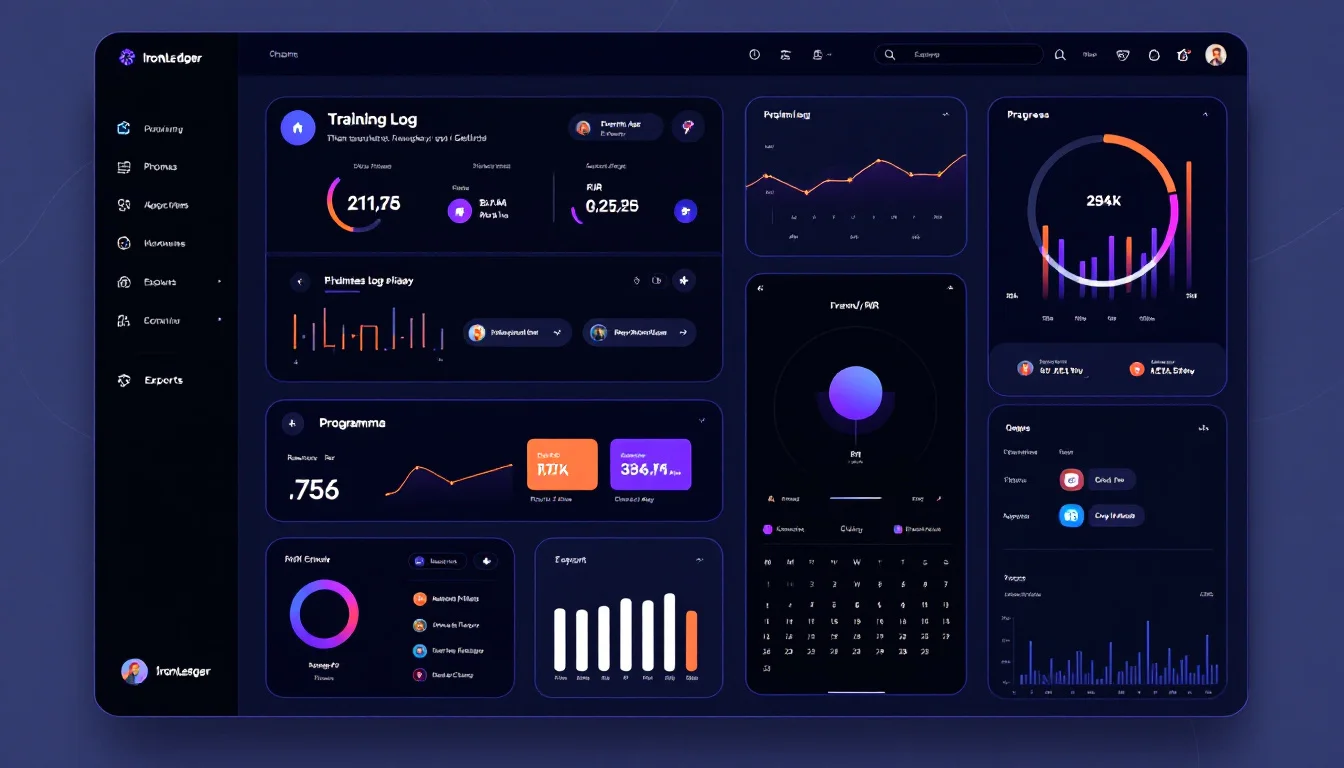
IronLedger's programmes page verifies three entry points: built-in programme structures, custom multi-week blocks, and CSV or Excel import. It also verifies import preview warnings, source attachment, deload markers, exercise-level prescription, week and day reordering, and completed-workout export.
Those details matter for a self-coached lifter because programme context stops the app from misreading deliberate changes. A lower-volume deload week is not a failed week. A paused bench block is not the same thing as a touch-and-go bench block. A skipped accessory set is different from a planned taper.
If your training starts in a spreadsheet, read the workout app with spreadsheet import checklist before moving a live block into any app. The import should preserve week, day, exercise, set target, rep target, effort target, notes, deload labels, and exportability.
Which progress metrics should appear after the workout?
After the workout, an iPhone strength app should show personal records, estimated 1RM, volume, exercise history, weekly trends, and programme completion. These metrics matter only when they stay connected to the exact sets that produced them. A clean chart built from messy logging is not trustworthy.
Start with personal records, but do not let PRs dominate the whole review. A load PR is useful. Rep PRs, volume PRs, and estimated 1RM PRs can be just as useful during submaximal training blocks. The personal record tracker app checklist explains why every PR should point back to the exercise variation, load, reps, rest, notes, and effort behind it.
Estimated 1RM helps compare submaximal performances across weeks. IronLedger's progress page verifies estimated 1RM using the Epley estimate, plus personal records, training volume, weekly and exercise-level trends, and chronological exercise history. The estimated one-rep max comparison explains why e1RM is best used as a trend rather than a promised max.
Volume belongs in the same review. Schoenfeld, Ogborn, and Krieger's 2017 meta-analysis included 34 treatment groups from 15 studies. The authors found weekly resistance-training volume significantly affected muscle-size changes, with each additional weekly set associated with a 0.37% higher percentage gain and higher versus lower volume differing by 3.9 percentage points.
Those volume findings do not mean every lifter should add sets. They mean the app should show volume beside performance and effort. If volume rises while estimated 1RM falls and RPE climbs, the app is probably showing fatigue. If volume rises and comparable lifts improve at similar effort, the added work may be productive.
The broader workout tracking metrics guide covers how load, reps, RPE/RIR, rest, notes, volume, PRs, estimated 1RM, and exercise history work together. A strength app for iPhone should make that review possible without forcing you to rebuild the session later in another file.
When is iPhone logging better than paper, notes, or spreadsheets?
An iPhone strength app is better than paper, notes, or spreadsheets when retrieval matters during the workout and automatic review matters after it. Paper is still excellent for simple sessions. Spreadsheets are still excellent for custom planning. A dedicated app wins when quick entry, previous values, PRs, RPE/RIR, history, and export all matter.
Use the tool that answers your next training decision with the least friction:
| Logging system | Best fit | Main strength | Main limitation |
|---|---|---|---|
| Paper logbook | Simple programmes and lifters avoiding phones | Fast, focused, no battery or account issue | Manual search, manual maths, no automatic backup |
| Notes app | Casual logging and short routines | Familiar text entry | Weak structure, poor history, no reliable analytics |
| Spreadsheet | Custom blocks and percentage planning | Full control over formulae and layout | Slow phone entry during sessions |
| iPhone strength app | Self-coached progression from history | Fast logging plus previous values, PRs, e1RM, volume, and export | Requires choosing a tool and learning the workflow |
Burke, Wang, and Sevick's 2011 systematic review described self-monitoring as the centrepiece of behavioural weight-loss interventions. That review was not a strength-training app trial, so the claim should stay narrow: a system you actually use is better than a perfect dashboard you abandon.
For strength athletes, the best iPhone app is the one you can use accurately under gym conditions. Weak reception, short rest periods, equipment swaps, and warm-up changes are normal. The app should handle those conditions without turning the session into admin.
Is IronLedger a good fit for iPhone strength training?
IronLedger is a good fit for iPhone strength training when you want the programme, the set log, and the progress review in one strength-specific record. IronLedger is available now on the Apple App Store, while Android lifters can join closed testing through Google Play.
IronLedger's download page verifies the iPhone availability. The same page explains the Android closed-test path. That distinction matters because a search for an iPhone lifting app should not blur current iOS access with Android release status. Android lifters should use the Android workout tracker app checklist to judge Google Play access, Health Connect context, offline logging, and export before moving a live training block.
IronLedger's product page verifies the active-session layer: load, reps, RPE or RIR, notes, set completion, rest, supported set types, previous values, exercise reorder, exercise replacement, adding or removing supported exercises, optional per-set form-check video, offline session logging, supported cloud backup and sync, and portable CSV workout export.
IronLedger's programmes page verifies the planning layer: built-in programme structures, custom multi-week blocks, CSV and Excel import, import review warnings, deload markers, exercise-level prescription, source attachment, and completed-workout export. The progress analytics page verifies PRs, estimated 1RM using the Epley estimate, training volume, weekly and exercise-level trends, and exercise history.
IronLedger's integrations page verifies supported integration paths for Apple Health, Health Connect, Strava, and Oura, with availability depending on platform, release stage, permissions, and account configuration. Treat integrations as supporting context. The strength log should remain the source record for sets, reps, effort, targets, PRs, and training decisions.
What mistakes make iPhone workout tracking misleading?
Phone workout tracking becomes misleading when the app captures numbers without the standards behind them. The common mistakes are mixing exercise variations, skipping effort, ignoring rest, hiding programme targets, treating estimated 1RM as a guarantee, and locking the record inside one app.
Avoid these errors:
- Mixing exercise names. "Incline DB press" and "dumbbell incline bench" can split history unless naming stays consistent.
- Skipping RPE or RIR. Load and reps alone cannot show whether a set was repeatable or a grinder.
- Ignoring rest. A five-minute rest and a 90-second rest can produce different training signals from the same load.
- Hiding programme targets. A completed set needs the prescribed reps, load, effort, and week beside it.
- Chasing estimated 1RM. e1RM is a trend signal, not a guarantee that today's true max is available.
- Counting all volume equally. Warm-ups, technique sets, hard working sets, and failure sets do not carry the same meaning.
- Skipping export. A serious training history should remain readable if you later change tools.
A good app should make restraint easier. If the same load is getting harder for three sessions, the iPhone log is not telling you to force a bigger number. The log is telling you to review fatigue, rest, volume, technique, or the programme.
Strength training app for iPhone FAQs
Frequently asked questions
The best strength training app for iPhone is the one that records load, reps, RPE/RIR, rest, notes, programmes, PRs, estimated 1RM, volume, history, and exportable data quickly enough to use during workouts.
Sources and references
- American College of Sports Medicine position stand: Progression models in resistance training for healthy adults — states that progressive resistance-training protocols are necessary and details programme variables such as loading, exercise order, rest, and frequency (2009).
- Zourdos et al., Novel resistance training-specific rating of perceived exertion scale measuring repetitions in reserve — study of 29 squatters using RPE/RIR mapping, including RPE 10 = 0 RIR and RPE 9 = 1 RIR (2016).
- Schoenfeld, Ogborn, and Krieger, Dose-response relationship between weekly resistance training volume and increases in muscle mass — meta-analysis of 34 treatment groups from 15 studies finding a graded relationship between weekly sets and hypertrophy (2017).
- Burke, Wang, and Sevick, Self-monitoring in weight loss — systematic review describing self-monitoring as central to behavioural weight-loss interventions (2011).
- IronLedger download page — verifies Apple App Store availability and the Android Google Play closed-test path (2026).
- IronLedger product page — verifies set-level workout logging, RPE/RIR, rest, notes, set types, previous values, optional set video, offline logging, supported cloud sync, and CSV export (2026).
- IronLedger programmes page — verifies built-in structures, custom blocks, CSV and Excel import, import review warnings, deload markers, exercise-level prescription, and export (2026).
- IronLedger progress page — verifies personal records, estimated 1RM using the Epley estimate, training volume, weekly and exercise-level trends, and exercise history (2026).
Keep learning