A single bad night of sleep does little to your maximal strength, according to the best available review. A run of short nights is different: it can reduce force output on multi-joint lifts such as the squat, bench press and deadlift, while single-joint exercises hold up better.
That difference should shape what you do when you wake up tired. This guide covers what the studies measured, what they did not, how much sleep adults are advised to get, and a simple way to adjust a session by effort. It also shows how to record sleep context in your log so a rough week is not mistaken for a stall.
Does poor sleep reduce strength?
Poor sleep reduces strength mainly when it is repeated. A systematic review of 17 studies found little effect from a single night of total sleep deprivation, but consecutive nights of restricted sleep reduced force output on multi-joint movements. Single-joint movements were not reduced in the same way.
The review, by Knowles et al. (2018), rated the included studies as moderate or weak quality, so the conclusions are indicative, not final. Its main conclusion was that inadequate sleep impairs maximal strength in compound movements when performed without specific interventions designed to increase motivation.
That wording matters. The review does not say your muscles lose the ability to produce force after one night. It says that on the compound lifts, with several short nights behind you and no extra motivation, the heaviest efforts suffer. Hormonal responses to resistance training were conflicting across the studies, so there is no tidy hormonal explanation to point to.
What did the main studies find?
The studies point the same way: strength on big lifts falls after repeated short sleep, while a single night has a smaller, less consistent effect. The table summarises the four sources used in this article, with the sample sizes that limit how far each result stretches.
| Study | Who and what | Finding |
|---|---|---|
| Knowles et al. (2018) | Systematic review, 17 studies, moderate or weak quality | Sleep deprivation had little effect on strength; consecutive nights of restriction reduced multi-joint force output |
| Reilly and Piercy (1994) | 8 young men, 3 hours' sleep for 3 nights | Maximal bench press, leg press and deadlift fell; maximal biceps curl did not |
| Lamon et al. (2021) | 13 adults, one night without sleep | Muscle protein synthesis 18% lower, cortisol 21% higher, testosterone 24% lower |
| Watson et al. (2015) | AASM and Sleep Research Society consensus statement | Adults should regularly sleep 7 or more hours; under 7 is linked to impaired performance |
Treat each row as one piece of evidence. The 1994 and 2021 studies are small, and both used young, healthy participants, so they will not map exactly onto an older lifter, a lifter returning from injury, or someone who has been short on sleep for months.
What happens to your lifts after several short nights?
After several short nights, expect heavy compound lifts to drop first and submaximal work to follow. In the best-known test, three consecutive nights of three hours' sleep lowered maximal bench press, leg press and deadlift. Maximal biceps curl was unaffected.
Reilly and Piercy (1994) studied eight young men over a three-night sleep restriction period against a control period of normal sleep. For each exercise they set a load the participant could lift for 20 repetitions, then found the maximal lift. The submaximal lifts declined on all four tasks, with the deterioration significant after the second night.
Two details are worth taking from that. First, the effect appeared within two nights, so a short run of bad sleep is enough to matter. Second, the curl was fine while the bench press, leg press and deadlift were not, which matches the review's multi-joint finding. If your deadlift and squat sag in a week of poor sleep while your curls and lateral raises feel normal, that is a recognisable pattern, not a sign that your programme has stopped working.
What does sleep loss do to muscle building?
Sleep loss appears to blunt muscle building in the short term. In one small experiment, a single night without sleep lowered muscle protein synthesis by 18% and shifted hormones in an unfavourable direction. The study did not follow participants long enough to show whether any muscle was actually lost.
Lamon et al. (2021) tested 13 healthy young adults (seven men, six women) in a randomised crossover, comparing one night of total sleep deprivation with a night of normal sleep. Muscle protein synthesis fell from 0.072 to 0.059 per cent per hour. Plasma cortisol was 21% higher and plasma testosterone 24% lower. Markers of protein breakdown did not differ.
The authors described the result as anabolic resistance and a pro-catabolic environment. In plain terms, the signal to build was weaker after the bad night. That is a mechanism, not an outcome. Nobody lost a measured amount of muscle in this study, and one poor night followed by good sleep is a very different exposure from months of short sleep. The reasonable takeaway is that sleep supports the recovery your training depends on, so repeated shortfalls are a cost you pay with progress rather than a free trade for extra hours of work.
How much sleep do lifters need?
Lifters need what other adults need: seven or more hours a night on a regular basis. That is the consensus recommendation of two sleep bodies. Sleeping under seven hours regularly is linked to adverse health outcomes and impaired performance, and there is no separate figure for strength athletes.
The recommendation comes from the AASM and Sleep Research Society consensus statement by Watson and colleagues. It also says that sleeping more than nine hours on a regular basis may be appropriate for young adults, people recovering from sleep debt, and people with illnesses.
Because the statement is about health in general, it will not tell you the ideal figure for your own training. A practical way to find out is to compare your logged sessions against how long you slept. If your best sessions cluster after seven-to-eight-hour nights and your worst after five-hour nights, that is more useful to you than any population average.
Supplements will not replace those hours. Creatine, for example, adds only a few kilograms to squat strength on average, as the creatine and strength guide explains, which is less than a bad week of sleep can take away.
How should you adjust training after a bad night?
After one bad night, keep the session and change how you run it. Let effort decide the load: if the warm-ups feel unusually heavy, hold the planned weight instead of adding to it, keep top sets at about RPE 8, and leave maximal attempts for another day.
RPE 8 means roughly two repetitions left in reserve. This is the author's practical reasoning, not a protocol any study tested, but it follows from the research: the strength loss in these studies was in maximal and near-maximal efforts, so staying away from them costs you little. It is an application of autoregulated training, where the day's effort overrides the written number.
The table below turns that into a simple lookup. The sleep thresholds are the author's own reasoning, not research findings, so adjust them to how you actually respond.
| Sleep situation | What to do |
|---|---|
| 7 or more hours | Train as planned and progress as normal |
| One night of about 5 to 6 hours | Train as planned; cap top sets near RPE 8; no max attempts |
| One night under 4 hours | Hold loads; trim a set or two on compound lifts; no PR attempts |
| Several short nights in a row | Cut volume on squat, bench and deadlift variations; keep loads submaximal |
| Short nights for a week or more | Plan a deload week and look at other stressors |
If your programme uses a top set followed by lighter work, you can keep the back-off sets and drop or soften the top set. The top set and back-off sets guide explains how that structure works.
Do not skip the session by default. The research gives no reason to think a normal session after one poor night does harm, and it rarely makes sense to waste a training day on a single short night. If the shortfall drags on for a week or more, the better question is whether you are heading towards the pattern described in overtraining vs overreaching, where disturbed sleep is one of several signs that recovery is not keeping up with the work.
How do you log sleep alongside training?
Log sleep as a short note next to the effort rating, and look for the pattern later. A line such as "slept about 5 hours" on the first working set is enough. The point is to give a weak session a cause, so one bad day does not read as a stall.
The most useful things to record are the load, reps and RPE or RIR for each set. Effort is what shows a hidden cost: the same weight for the same reps at a higher RPE than last week means the day was harder than the number on the bar suggests. The workout tracking metrics guide covers which fields to track and why.
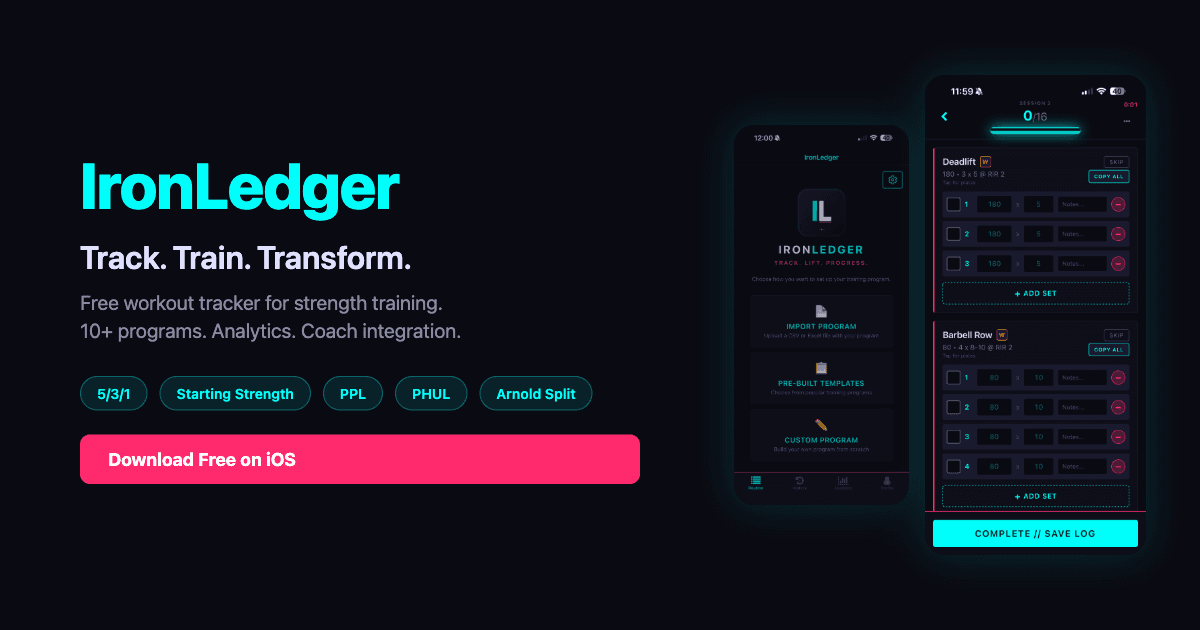
IronLedger's product page lists per-set logging with RPE in half steps, RIR as an alternative, and free-text notes on the set that stay in your history. That is enough to write a sleep note and compare it with effort later. The Dashboard also has a sleep tile where you type in last night's sleep, which stays on your phone, but it isn't attached to a set, so the note is still the easiest way to tie a short night to a session.
If you wear an Oura ring, the integrations page lists Oura as coming soon, so IronLedger doesn't read your readiness score today. Your recommended loads keep following your logged sets under the progression rule described here. For when a readiness score is worth trusting, read readiness score vs training log.
What mistakes should you avoid?
Most mistakes come from overreacting in one direction or the other: either ignoring a run of bad nights and forcing PR attempts, or treating one poor night as a reason to abandon the week. Both stem from reading a single data point as the trend.
- Chasing a PR on a short night. Maximal efforts on compound lifts are where the research shows the loss.
- Reading one weak session as a plateau. Look at several sessions and the notes beside them before changing the programme.
- Ignoring what disrupts sleep. Alcohol changes sleep structure even when you fall asleep quickly; see alcohol and strength training for what the research shows.
- Logging weight and reps but not effort. Without RPE or RIR, a heavy day and a normal day look identical.
- Treating caffeine as the plan. For what caffeine does and does not add to your lifts, see caffeine and strength training. The Knowles review mentions motivation strategies such as caffeine or training in a group as ways to support performance, but they do not replace sleep, and this article makes no dosage recommendation.
- Ignoring a pattern. If several nights a week are short for weeks on end, no adjustment to the session will make up for it.
Frequently asked questions
Yes, but run the session by effort. Hold loads if warm-ups feel heavy, keep top sets near RPE 8, trim a set or two on compound lifts, and skip maximal attempts. This is practical reasoning, not a tested protocol.
Sources and references
- Knowles et al., Inadequate sleep and muscle strength: Implications for resistance training — systematic review of 17 studies; sleep deprivation had little effect on strength, while consecutive nights of restriction reduced multi-joint force output (2018).
- Reilly and Piercy, The effect of partial sleep deprivation on weight-lifting performance — eight men, three nights of three hours' sleep; maximal bench press, leg press and deadlift fell, maximal biceps curl did not (1994).
- Lamon et al., The effect of acute sleep deprivation on skeletal muscle protein synthesis and the hormonal environment — 13 adults; one night without sleep lowered muscle protein synthesis by 18% and testosterone by 24% (2021).
- Watson et al., Recommended amount of sleep for a healthy adult: AASM and Sleep Research Society consensus statement — adults should regularly sleep seven or more hours per night (2015).
- IronLedger product page — per-set RPE in half steps, RIR and notes kept in history.
Keep learning