Push Pull Legs and Upper/Lower are the two most common splits an intermediate lifter graduates into, and both show up as free, built-in templates in IronLedger's program library. The debate over which one "wins" usually skips the actual question: does the split label change your results, or does it just change how the same weekly work gets divided across the calendar?
The research on split structure says the second option does most of the work. A 2024 meta-analysis found no significant strength or hypertrophy difference between split and full-body training when weekly volume is matched, and a frequency meta-analysis shows both a standard 6-day PPL and a standard 4-day Upper/Lower already train each muscle group twice a week — the frequency that evidence favours for growth.
What genuinely differs is session count, how densely each session is packed, and which one you'll actually keep showing up for. That's the comparison worth having.
What Are Push Pull Legs and Upper/Lower Splits?
Push Pull Legs (PPL) is a resistance-training split that groups sessions by movement pattern — pushing, pulling, and leg work — typically across six weekly sessions. Upper/Lower is a resistance-training split that groups sessions by body region — upper body and lower body — typically across four weekly sessions.
A standard PPL week runs Push, Pull, Legs, Push, Pull, Legs: push days cover chest, shoulders, and triceps; pull days cover back and biceps; leg days cover the entire lower body. The full push pull legs guide covers exercise selection and the 3-day, 4-day, and 6-day variants in more depth. A standard Upper/Lower week runs Upper, Lower, Upper, Lower: each upper session clusters chest, back, shoulders, and arms into one sitting, while each lower session covers quads, hamstrings, glutes, and calves. The 4-day workout split program guide covers Upper/Lower alongside other 4-day structures like PHUL.
Run at their standard length, both splits land each muscle group two sessions a week — PPL by running the same three session types twice, Upper/Lower by running two session types twice. The six-versus-four day count is the most visible difference, but it isn't automatically a frequency difference once you compare like for like.
Does PPL or Upper/Lower Build More Muscle?
Neither split has a demonstrated hypertrophy advantage over the other. The clearest evidence on this question doesn't come from a PPL-vs-Upper/Lower trial directly — none exists — but from research on split structure generally, and it points the same way regardless of how you label the split.
Ramos-Campo, Benito-Peinado, Andreu-Caravaca, Rojo-Tirado and Rubio-Arias (2024), publishing in the Journal of Strength and Conditioning Research, ran a systematic review and meta-analysis of 14 studies (392 subjects) comparing split routines against full-body routines. They found no significant difference in muscle cross-sectional area of the elbow extensors (p = 0.84), elbow flexors (p = 0.91), vastus lateralis (p = 0.93), or lean body mass (p = 0.92) between the two approaches when volume was equated.
"Individuals are free to confidently select a resistance training routine based on their personal preferences." — Ramos-Campo et al. (2024), Journal of Strength and Conditioning Research
That conclusion generalises directly to PPL versus Upper/Lower, since both are just different ways of dividing the same weekly volume across sessions. The frequency piece backs this up: Schoenfeld, Ogborn and Krieger's (2016) meta-analysis of 10 studies found that training a muscle group at least twice a week produces significantly greater hypertrophy than once a week, at equal volume. A standard PPL and a standard Upper/Lower both clear that twice-weekly bar, so neither sits on the disadvantaged side of the frequency evidence. What actually drives growth is total weekly sets per muscle group, which you can hit through either structure.
Does PPL or Upper/Lower Build More Strength?
Strength outcomes show the same pattern as hypertrophy: no significant advantage for either split once volume is matched. Ramos-Campo et al. (2024) found no significant difference in bench press strength (mean difference = 1.19, 95% CI -1.28 to 3.65, p = 0.34) or lower-limb strength (mean difference = 2.47, 95% CI -2.11 to 7.05, p = 0.29) between split and full-body training.
Frequency research adds useful context on how session count interacts with strength. Ochi et al. (2018) trained 20 untrained men for 11 weeks on volume-matched knee extensions: one group trained once weekly (6 sets of 12 reps at 67% estimated 1RM), the other three times weekly (2 sets of 12 reps at the same load, same weekly total). The three-times-weekly group gained significantly more strength (65.2 ± 23.2%) than the once-weekly group (43.5 ± 15.5%).
That result is about frequency, not split labels, and it's worth being precise about what it does and doesn't say here: since a standard PPL and a standard Upper/Lower both already train each muscle twice weekly, neither one is the "once weekly" condition Ochi's study showed underperforming. Both splits should be expected to perform similarly for strength for the same reason they perform similarly for hypertrophy — matched frequency, matched volume.
How Does Session Structure and Fatigue Compare Between the Two?
The real structural difference between PPL and Upper/Lower isn't frequency — it's how many muscle groups get packed into a single session. PPL spreads training across more, narrower sessions; Upper/Lower concentrates it into fewer, denser ones.
A push day in PPL trains roughly two to three muscle groups (chest, shoulders, triceps). An upper day in Upper/Lower trains four to five in the same sitting (chest, back, shoulders, biceps, triceps). Ochi et al. (2018) found that the lower-frequency, larger-session group in their trial reported significantly higher per-session RPE (7.3-8.3) than the higher-frequency, smaller-session group (4.3-5.3, p < 0.01) — a finding about session density and fatigue, not about split type, but one that reasons across cleanly: cramming more muscle groups into one sitting tends to raise how hard that single session feels, even when the total weekly work is identical.
| Factor | Push Pull Legs (6-day) | Upper/Lower (4-day) |
|---|---|---|
| Sessions per week | 6 | 4 |
| Muscle groups per session | 2-3 (single movement pattern) | 4-5 (whole body region) |
| Weekly frequency per muscle group | 2x | 2x |
| Typical session length | Shorter, narrower focus | Longer, broader focus |
| Primary fatigue challenge | More total sessions to recover between | Higher density and fatigue within each session |
Neither profile is objectively worse — a lifter who dislikes long sessions will find PPL's shorter, narrower days easier to manage; a lifter who dislikes being in the gym six days a week will find Upper/Lower's denser-but-fewer sessions preferable, even if any single session runs longer.
Which Split Fits Your Weekly Schedule Better?
Upper/Lower fits a limited or unpredictable schedule better, because it reaches the same twice-weekly muscle-group frequency in four sessions instead of six. PPL fits a lifter with reliable access to six training days, since that's the session count its standard structure assumes.
Missing a single session also costs each split differently. Skip a Wednesday Upper day and you still have Thursday's Lower session and a second Upper session later that week to keep frequency intact. Skip a Push day in a 6-day PPL week and the next Push session slides back, pushing that muscle group's second weekly session later or off entirely if the week is already full. A broader look at split options covers how this scheduling trade-off plays out across other structures beyond just these two.
Running PPL below six days changes its frequency math. A 3-day PPL-rest-PPL-rest pattern drops each muscle group back to once-weekly training — the condition the frequency research above shows is the less favourable side of the evidence — so a partial-week PPL isn't a smaller version of the same programme, it's a different frequency programme entirely.
Which Split Is Easier to Stick to Long-Term?
Neither split has a measured, direct dropout-rate comparison — that study doesn't exist. What the adherence research does show is that consistency in your first month predicts whether you stay on any programme far more than which split you chose.
Conti, Marzagão, Galpin and Schoenfeld (2026) tracked 389,481 mobile-app users, including 100,709 beginners, and found only 10.1% of beginners were still training at 12 months, with median dropout at 19 weeks. Training consistency during the first 28 days was the strongest predictor of long-term adherence: each standard-deviation increase in early active training days was linked to a 27% lower dropout hazard at week 11 (HR 0.73), 13% lower at week 26 (HR 0.87), and 9% lower at week 40 (HR 0.91).
Applied honestly to PPL versus Upper/Lower, that means the split most likely to get you to 12 months is whichever one matches the number of sessions you can genuinely show up for in month one — not the one with the theoretically better numbers on paper.
What Lifters Are Saying
Self-coached lifters running PPL commonly report liking its shorter, narrower sessions and the clear sense of "what today is for," but some also describe six weekly sessions becoming hard to sustain around travel, shift work, or a busy social calendar — exactly the failure mode the scheduling section above describes.
Lifters running Upper/Lower commonly report that four sessions feel more forgiving to miss and easier to fit around an unpredictable week, with the trade-off being that upper days can feel long and crowded by the time arm work comes around at the end. A few note that denser sessions make it harder to give later exercises the same effort as the first ones.
Neither preference is universal, and both groups tend to agree on the same underlying point: the split that gets abandoned by month two was never really being compared fairly against the one a lifter actually finished.
How Do You Log a PPL or Upper/Lower Split in IronLedger?
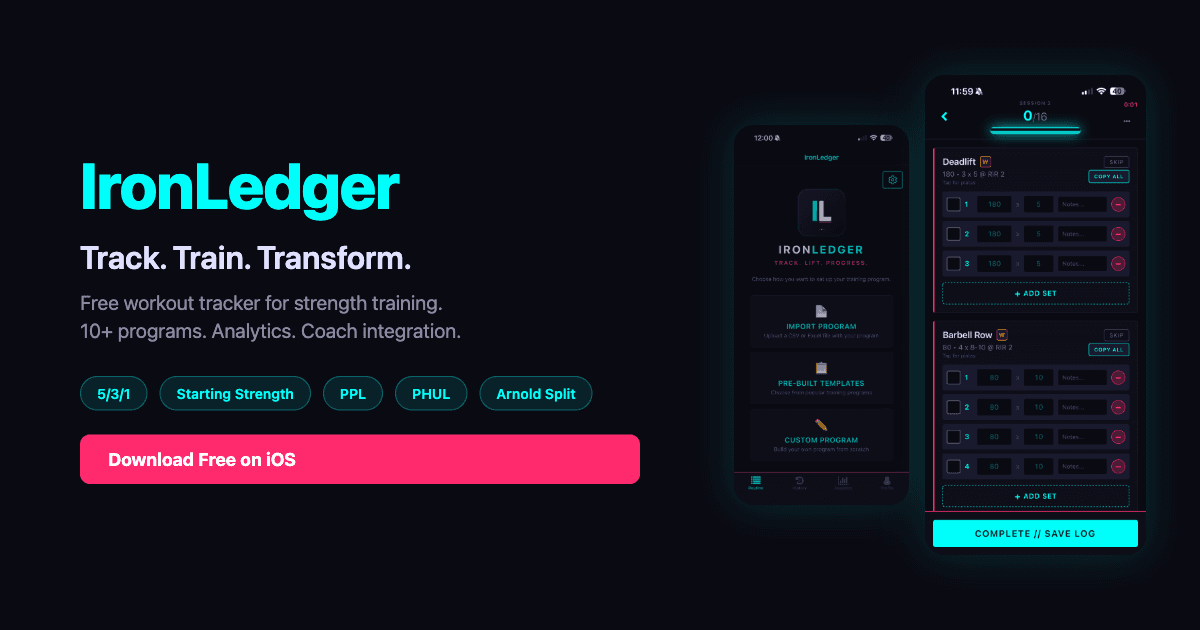
IronLedger logs both splits the same way, because the app tracks sets, not split philosophy. IronLedger's program library lists "Push Pull Legs" (6 days/week, tagged Split and Volume) and "Upper/Lower Powerbuilding" (4 days/week, tagged Power and Hypertrophy) as two of its ten free built-in templates.
Every set you log — on either template — carries the same fields: load, reps, an RPE rating on a 0-10 scale or an RIR rating on a 0-5 scale, and an optional note. IronLedger tracks a personal record and an Epley-estimated 1RM per exercise and rolls your logged history into a per-exercise progress trend, so a bench press logged on a PPL push day and the same lift logged on an Upper/Lower upper day feed the exact same progressive overload tracking — nothing about the split you're running changes how that exercise's numbers accumulate.
None of IronLedger's three progression rules — linear load, RPE/RIR hold-advance, or percentage of PR — care which template produced the set. The app doesn't recommend one split over the other or calculate an "optimal" choice; it gives you a structured starting template for whichever one you pick and logs what you actually do against it.
| If you... | Choose... | Why |
|---|---|---|
| Can realistically commit to 6 sessions a week | Push Pull Legs | Matches its standard structure without dropping frequency below twice weekly |
| Can only commit to 3-4 sessions a week | Upper/Lower | Reaches the same twice-weekly per-muscle frequency in fewer total sessions |
| Have an unpredictable or shift-based schedule | Upper/Lower | Missing one session still leaves two more that week to hit each muscle group again |
| Prefer shorter, narrowly focused sessions | Push Pull Legs | Each session covers 2-3 muscle groups instead of the 4-5 clustered into an Upper/Lower day |
| Are newer to structured training | Upper/Lower | A 6-day frequency is easier to sustain once you've built the work capacity a 6-day week demands |
| Aren't sure you'll stay consistent in month one | Whichever matches your realistic weekly availability | Early consistency, not split type, is the strongest known predictor of 12-month adherence (Conti et al., 2026) |
Which Split Should You Actually Choose?
Choose based on the number of sessions you can reliably deliver every week, not on a belief that one split has a hidden physiological edge — the evidence above says it doesn't have one. A 6-day PPL and a 4-day Upper/Lower, run as designed, train each muscle group with the same weekly frequency and produce statistically indistinguishable strength and hypertrophy outcomes.
If you can commit to six sessions and prefer shorter, narrower workouts, PPL gives you that without sacrificing frequency. If four sessions is your realistic ceiling, or you'd rather have more full rest days in the week, Upper/Lower reaches the same frequency target in fewer sessions. Either one, logged consistently in IronLedger from week one, will outperform the "better" split you abandon by week eight.
Frequently asked questions
Neither. Ramos-Campo et al. (2024) found no significant hypertrophy difference between split structures when weekly volume is matched, and both standard PPL and Upper/Lower train each muscle twice weekly.
Sources and references
- Ramos-Campo, Benito-Peinado, Andreu-Caravaca, Rojo-Tirado & Rubio-Arias, 2024 — "A meta-analysis of 14 studies (392 subjects) found no significant difference in strength (bench press p = 0.34, lower-limb p = 0.29) or muscle cross-sectional area (p = 0.84-0.93) between split and full-body resistance training when volume was equated." Journal of Strength and Conditioning Research 38(7):1330-1340 (2024).
- Ochi, Maruo, Tsuchiya, Ishii, Miura & Sasaki, 2018 — "In a volume-matched 11-week trial, training three times weekly produced significantly greater strength gains (65.2%) than training once weekly (43.5%), with significantly lower per-session RPE (4.3-5.3 vs 7.3-8.3, p < 0.01)." Frontiers in Physiology 9:744 (2018).
- Schoenfeld, Ogborn & Krieger, 2016 — "A meta-analysis of 10 studies found training each muscle group at least twice weekly produced significantly greater hypertrophy than training once weekly, at equated total volume." Journal of Strength and Conditioning Research 30(7):1785-1791 (2016).
- Conti, Marzagão, Galpin & Schoenfeld, 2026 — "Tracking 389,481 mobile-app users, only 10.1% of beginners remained adherent at 12 months; consistency in the first 28 days was the strongest predictor of long-term adherence (27% lower dropout hazard at week 11 per standard-deviation increase in early active days)." Frontiers in Sports and Active Living (2026).
Keep learning