Hand spacing on the bench press is a lever-arrangement change, not a different exercise. Moving your grip in or out shifts how much work the elbows do relative to the shoulders, changes how far the bar has to travel, and — measurably — changes how much weight you can move.
Gym folklore has a simple rule for this: wide grip for chest, close grip for triceps. The EMG research below doesn't fully support that rule, and two of the studies compared here disagree with each other on how big the triceps effect actually is. Rather than smooth that over, this article lays out what each study found and where they conflict.
What Is the Difference Between Close-Grip and Wide-Grip Bench Press?
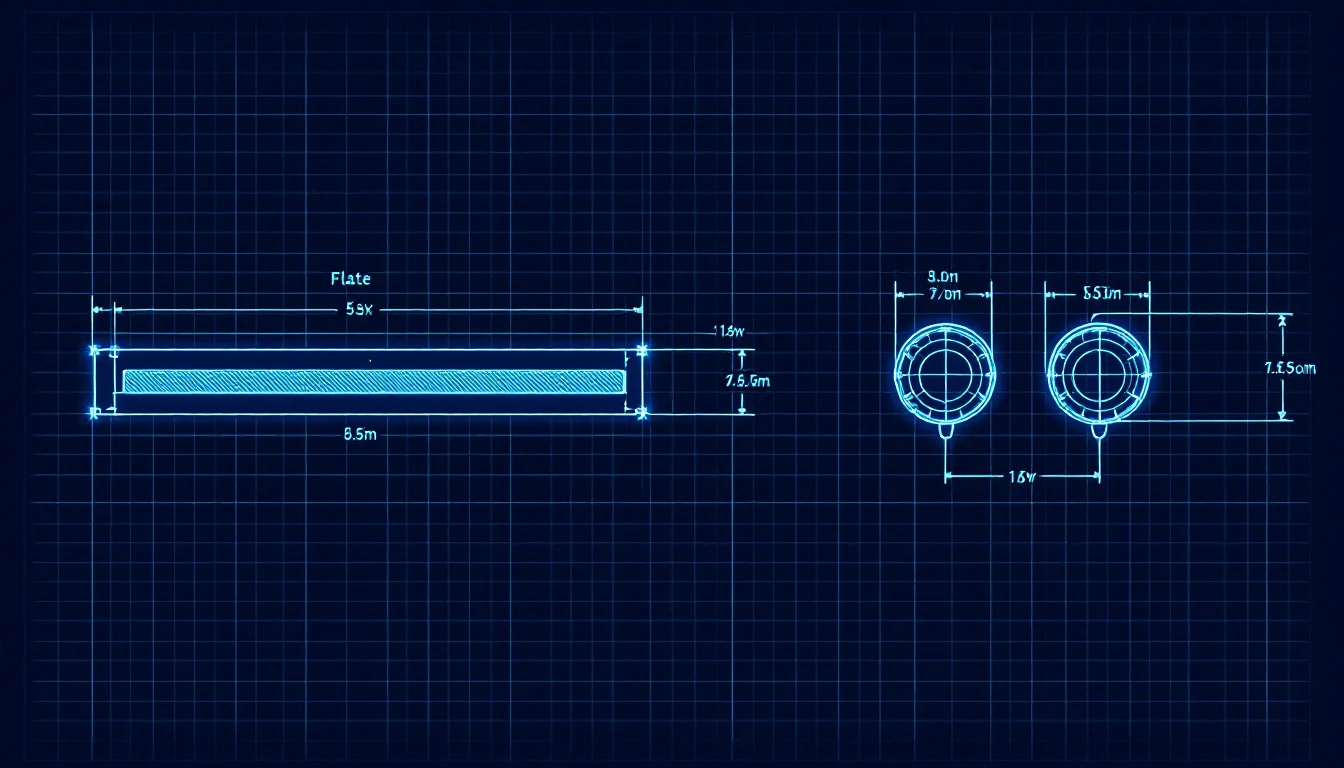
A close-grip bench press is a bench press performed with the hands at roughly shoulder width or narrower; a wide-grip bench press is performed with the hands out to the widest spacing allowed in competition, about 81cm between the index fingers. Both are the same lift, loaded the same way, with only the hand position changed.
That few-centimetre shift changes the geometry of the lift. A narrower grip increases the vertical distance the bar has to travel and increases the torque demanded of the elbow extensors, because the forearms stay closer to vertical throughout the press. A wider grip shortens that vertical bar path and shifts more of the torque onto the shoulder's horizontal-adductors — the muscles that pull the upper arm across the body.
Neither position is a variation you'd program instead of the bench press. It's the same lift with the load distributed differently across the same two joints.
Does Grip Width Change How Much Weight You Can Bench?
Yes. Saeterbakken, Stien, Pedersen, Solstad, Cumming and Andersen (2021) tested 28 lifters — 15 resistance-trained, 13 novice — across narrow, medium, and wide grips at a 6-rep max, and found narrow grip consistently cost lifters weight on the bar.
In the resistance-trained group, narrow-grip 6-RM loads were 7.0% lower than medium grip and 7.1% lower than wide grip (p < 0.001). In the novice group, narrow grip was 8.4% lower than medium and 6.6% lower than wide (p = 0.040 and p = 0.045). Neither group showed a significant difference between medium and wide grip.
The researchers attribute this to bar displacement: it is generally accepted that a wider grip shortens the vertical distance the bar travels, so the same load requires less mechanical work to move through a shorter range. That's a statement about physics, not about which grip is "better" — a wider grip doesn't recruit more strength, it asks less distance of the same strength.
For anyone tracking estimated 1RM across grip widths, this matters directly: switching from your usual grip to a narrower one will lower your working numbers even if nothing about your strength has changed, and the reverse is true switching to a wider grip.
Does a Close Grip Really Work the Triceps More?
The two studies compared here don't agree, and the disagreement is instructive rather than something to paper over. In Saeterbakken et al.'s (2021) dynamic 6-RM test, wide grip produced lower triceps brachii activation than medium or narrow grip (p ≤ 0.008), with no significant difference between narrow and medium grip.
"Grip widths affect both 6-RM loads and triceps brachii, biceps brachii, and anterior deltoid activity especially between wide and narrow grip widths." — Saeterbakken, Stien, Pedersen, Solstad, Cumming & Andersen (2021), International Journal of Environmental Research and Public Health
Lehman (2005) tested a different protocol entirely — isometric holds, not full dynamic reps — in 12 lifters, and found a much larger effect in the same direction: close grip produced 210% more triceps activity than wide grip. That's a far bigger gap than anything Saeterbakken et al. measured in a dynamic lift.
The honest read is that both studies agree on direction — a narrower grip asks more of the triceps than a wide one — but disagree sharply on magnitude, and the likely explanation is the protocol itself. An isometric hold at a fixed joint angle can recruit a muscle differently than a full concentric-eccentric rep through a changing range of motion, and Lehman's sample was smaller and almost two decades older. Don't take the 210% figure as what you should expect during a normal set of reps; take the direction as the more reliable finding.
One overlooked finding from the same 2021 study: biceps brachii activation rose sharply with grip width, not the triceps. In the resistance-trained group, wide grip produced 115.6% more biceps activation than narrow grip and 44.9% more than medium grip (both p < 0.001) — a bigger, cleaner effect than anything seen in the triceps data. Grip width does move the workload around, just not always in the muscle gym folklore expects.
Does Grip Width Change Chest Activation?
No, not meaningfully. Despite the "wide grip for chest" assumption, Saeterbakken et al. (2021) found no significant difference in pectoralis major activation — in either the sternocostal or clavicular head — across narrow, medium, or wide grip in either the trained or novice group.
Tanimoto, Arakawa, Sato and Nagano (2023) corroborate this from a different angle: measuring the ratio of pectoralis-to-triceps EMG contribution in 14 lifters (7 resistance-trained, 7 untrained) at a 10-rep max, they found no significant difference between narrow (40cm) and wide (81cm) grip in nearly every condition tested, the one exception being untrained lifters' fatigued eccentric phase.
Two separate research groups, two different protocols, the same conclusion: the pecs don't seem to care much about hand spacing. The differences that do show up are in the triceps and biceps, not the prime mover of the lift itself.
| Factor | Close-Grip Bench Press | Wide-Grip Bench Press |
|---|---|---|
| Bar path / range of motion | Longer vertical travel | Shorter vertical travel (Saeterbakken et al., 2021) |
| 6-RM load capacity | 6.6-8.4% lower than medium/wide (Saeterbakken et al., 2021) | Higher, no significant gap vs medium |
| Triceps activation | Higher in isometric holds (+210%, Lehman, 2005); similar to medium in dynamic reps | Lower than medium/narrow in dynamic 6-RM (Saeterbakken et al., 2021) |
| Biceps activation | Lowest of the three grips | Up to 115.6% higher than narrow (Saeterbakken et al., 2021) |
| Pectoralis major activation | No significant difference vs other grips | No significant difference vs other grips |
| Bar path drift | ~10% inward of vertical (Tanimoto et al., 2023) | ~30% outward of vertical (Tanimoto et al., 2023) |
| Typical use case | Triceps-lockout carryover, elbow-forward pressing patterns | Maximal raw load, competition-style pressing |
Does Bar Path or Shoulder Comfort Differ by Grip Width?
Neither grip width produces a perfectly straight bar path. Tanimoto et al. (2023) measured the lateral-to-vertical force ratio on the bar during wide- and narrow-grip pressing and found the bar drifted about 30% outward on a wide grip and about 10% inward on a narrow grip, in both resistance-trained and untrained lifters.
In practice, that means every lifter is pushing the bar on a slight diagonal rather than straight up, and the direction of that diagonal depends on hand spacing. Neither trained nor untrained lifters in the study corrected fully to a vertical path, which the authors suggest may reflect an efficient trade-off between shoulder and elbow demand rather than a technical flaw to fix.
On comfort: a wider grip places the shoulder into more horizontal abduction and external rotation under load, a position some lifters with shoulder sensitivity find less comfortable during heavy sets. This is general training guidance, not a clinical claim — if a particular grip width produces sharp or persistent shoulder pain, that's a reason to see a physiotherapist, not just to narrow your hands.
A very narrow grip trades that shoulder position for more elbow-extension torque, which some lifters instead feel as elbow strain rather than shoulder strain. There's no width that removes joint stress entirely; there's only a choice of which joint takes more of it.
How Should You Choose a Grip Width for Your Goals?
Choose a narrower grip if your goal is triceps-lockout carryover — useful if you tend to fail bench presses just before the elbows lock out — or if a wide grip's shoulder position bothers you. Choose a wider grip if your goal is the heaviest possible number on the bar, since the shorter bar path measured by Saeterbakken et al. (2021) is the direct mechanical reason wide grip supports more load at the same relative effort. A self-selected, roughly medium grip is a reasonable default that avoids both extremes' trade-offs.
Competition bench press rules cap grip width at 81cm between the index fingers, which is why "wide grip" in the research above tops out at that number — it's not an arbitrary lab choice, it's the same ceiling powerlifters train against.
What Lifters Report in Practice
Lifters training for a maximal total commonly report that a wide, competition-legal grip feels like the strongest position once they're used to it, echoing the load advantage Saeterbakken et al. measured directly. A frequent criticism from the same group is that a wide grip feels unstable or shoulder-heavy at first, and several report it took dedicated practice to stop feeling like the bar was pulling their arms apart.
Lifters training for triceps size or lockout strength more often prefer a close or medium grip, reporting a stronger stretch through the triceps and better carryover to close-grip presses and dips. A common complaint from this group is elbow discomfort when the grip gets too narrow, particularly under heavier loads or higher volume.
Neither preference is universal, and plenty of lifters run a competition-style wide grip for their main strength sets and a closer grip on an accessory press to target the triceps specifically — treating grip width as a training variable to manipulate deliberately rather than a single fixed choice.
How Do You Track Close-Grip and Wide-Grip Bench Press in the Same Log?
IronLedger logs a close-grip and a wide-grip bench press with the same fields — weight, reps, and either an RPE (0-10, half-step increments) or RIR (0-5) rating, plus an optional note — but keeps them as separate exercise entries rather than one blended "bench press" record, the same pattern used for tracking barbell vs dumbbell bench press as two distinct lifts.
That separation matters because a close-grip 6-RM and a wide-grip 6-RM aren't the same absolute load for most lifters, given the 6.6-8.4% gap Saeterbakken et al. measured above. Keeping each grip as its own exercise entry means each one gets its own personal-record history and its own estimated 1RM calculated by the Epley formula, rather than one number that jumps around every time you switch hand spacing.
IronLedger's progression engine then applies one of three rules — linear load, RPE/RIR hold-advance, or percentage-of-PR — to whatever you've logged for that specific grip, and always names which rule produced the recommendation. If you're running a block built around a training max, that max stays specific to the grip it was tested on. See how IronLedger decides your next weight for the full logic behind those three rules, the program library for built-in templates, or the product page for the complete logging feature set.
Frequently asked questions
Direction favours close grip: Saeterbakken et al. (2021) found wide grip had lower dynamic triceps activation, and Lehman (2005) found close grip produced far more triceps activity isometrically. The two studies disagree on how large the effect is.
Sources and references
- Saeterbakken, Stien, Pedersen, Solstad, Cumming & Andersen, 2021 — 28 lifters showed 6.6-8.4% lower 6-RM loads with a narrow grip than medium or wide grip, lower triceps activation with a wide grip than medium/narrow, and no significant pectoralis major difference across grip widths. International Journal of Environmental Research and Public Health 18(12):6444 (2021).
- Lehman, 2005 — an isometric study of 12 lifters found close-grip bench press increased triceps activity 210% compared with wide grip. Journal of Strength and Conditioning Research 19(3):587-591 (2005).
- Tanimoto, Arakawa, Sato & Nagano, 2023 — 14 lifters showed the bar drifted roughly 30% outward of vertical on a wide grip and roughly 10% inward on a narrow grip, with no significant pectoralis-to-triceps EMG ratio difference between grips. Sports (Basel) 11(8):154 (2023).
Keep learning